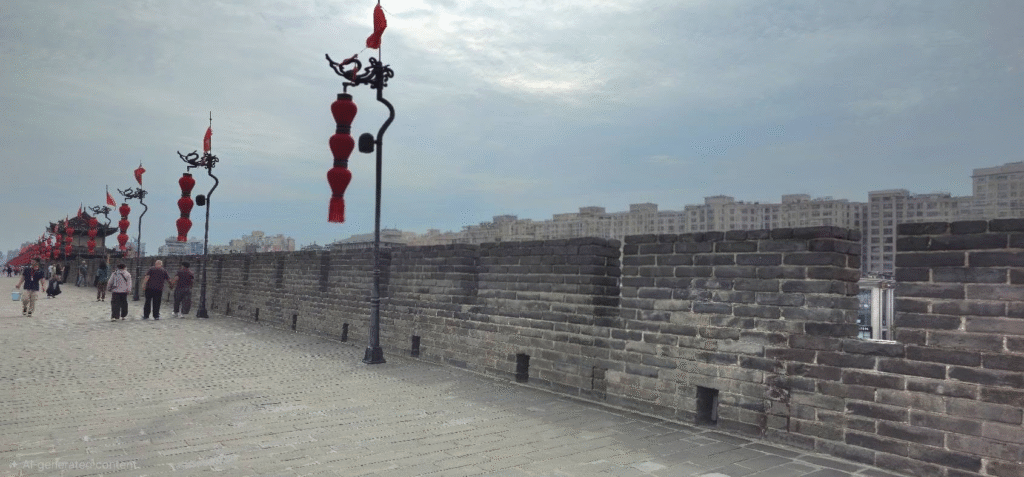
Xi’an, formerly known as Chang’an, was the capital of several important Chinese dynasties and stood at the eastern end of the ancient Silk Road.
I came to Xi’an expecting to meet history. What I did not expect was just how many different faces that history would have.
The Terracotta Army — An Army That Waited 2,000 Years to Be Found
The story of the discovery is almost unbelievable.
In March 1974, farmers in Lintong, east of Xi’an, were digging a well during a period of drought when they came across fragments of terracotta figures. What initially appeared to be broken pieces of pottery eventually led archaeologists to one of the most extraordinary archaeological discoveries of the twentieth century. Excavation of Pit No. 1 began that year, followed by Pits 2 and 3.
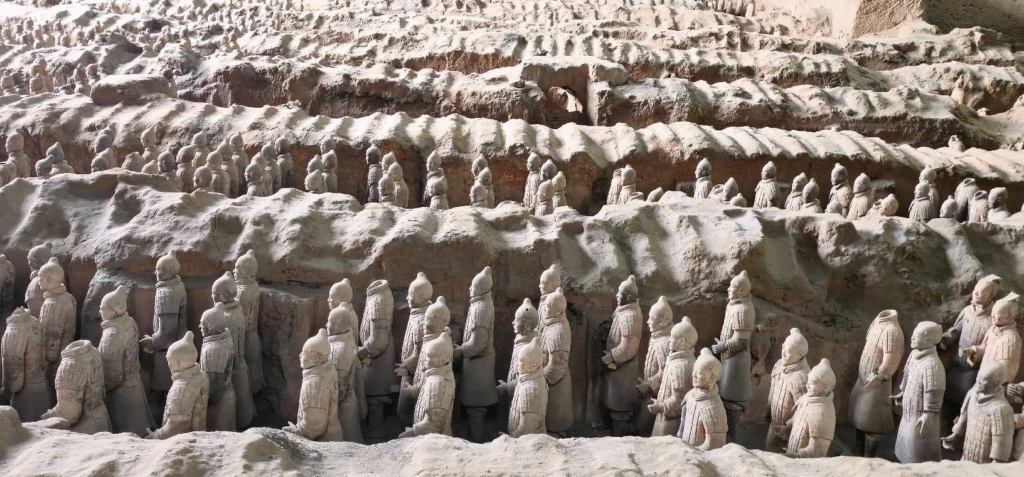
The warriors belong to the enormous mausoleum complex of Qin Shi Huang, the First Emperor of a unified China. The complex was begun in 246 BC, when he was still the young ruler of Qin, and was intended to accompany and protect him in the afterlife. UNESCO describes the mausoleum as a vast complex designed to mirror the urban plan of the imperial capital.
The emperor’s tomb itself has never been excavated.
The Terracotta Army is therefore only part of a much larger archaeological complex. Five decades of excavation have revealed hundreds of additional pits and tombs, bronze chariots and horses, weapons, acrobats, officials and other discoveries.
Pit No. 1, looking down at row after row of soldiers.
These aren’t simply anonymous statues. Archaeologists have found differences in facial features, hairstyles, clothing and poses. They were created to represent an actual military force, rather than simply being identical decorative figures. Standing there, looking down at thousands of silent soldiers, I couldn’t help wondering what it must have taken to create such an army — and what it must have meant to the people who made them. For more than two thousand years they waited beneath the earth, completely unaware that one day millions of curious visitors would come to look at them.
Dangjia Ancient Village — Walking Into Another China
From the grandeur of an emperor’s mausoleum, we move into the much more intimate world of Dangjia Village (党家村) in Hancheng.
The village dates back to 1331, during the Yuan dynasty, and flourished particularly during the Ming and Qing periods. It is known for its remarkably preserved traditional courtyard residences, narrow stone lanes and architectural details. It tells the story of ordinary families.
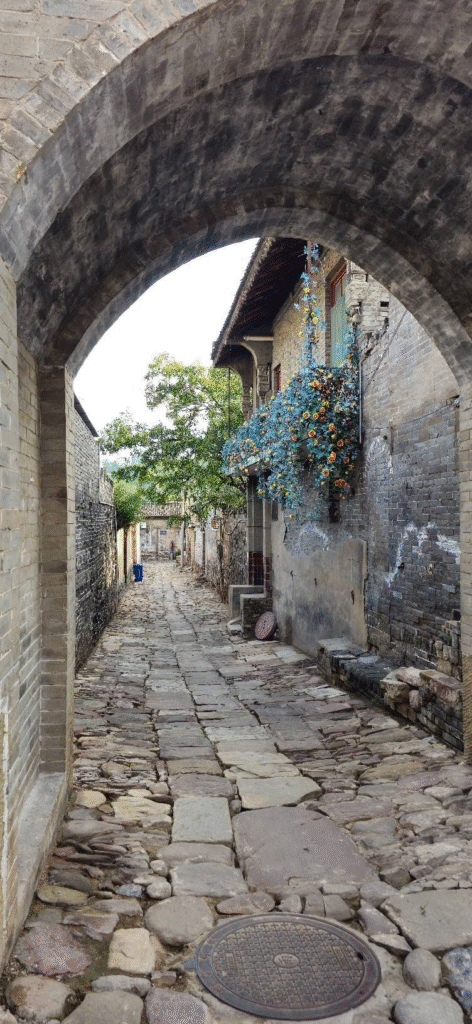
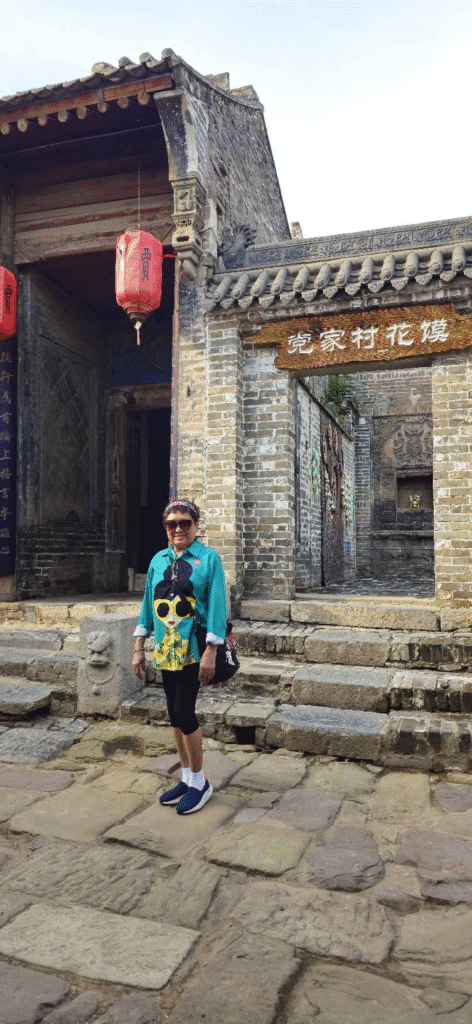
The village developed around the Dang and Jia clans, with traditional courtyard homes, ancestral halls, family inscriptions and architectural features reflecting the values and social structure of the families who lived there. Research on the village describes its unusual gourd-shaped setting and the way its traditional spatial organization developed over centuries.
If the Terracotta Army introduced me to the world of emperors, Dangjia Village introduced me to the world of ordinary people — families, homes, traditions and generations living within the same walls.
Xi’an City Wall — History You Can Actually Walk On
The present Xi’an City Wall was constructed during the Ming dynasty, beginning in 1370, on foundations associated with the earlier Sui and Tang imperial city. It was subsequently strengthened and repaired, including the addition of brick facing in the sixteenth century and major restorations later.
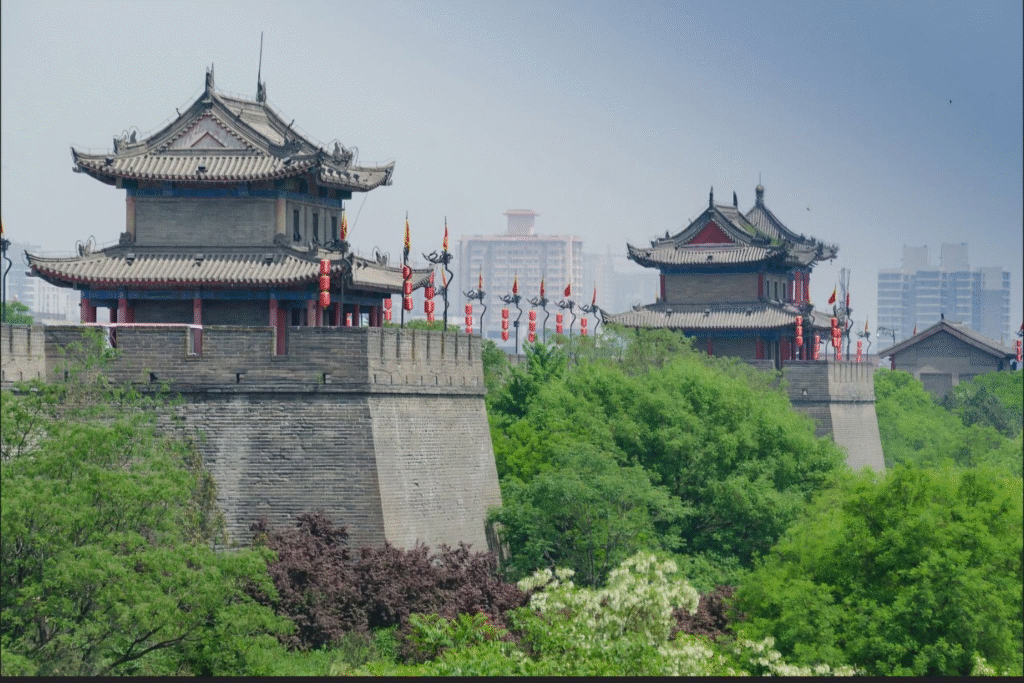
The wall forms a great rectangle around the historic centre, with gates, watchtowers, battlements and the moat below. Its preservation allows visitors to experience something that can otherwise feel very abstract when reading history books: the physical scale of an ancient fortified city. What makes it special isn’t merely its age. You can actually walk or cycle along it. There is something quite extraordinary about walking on a wall that has watched centuries pass beneath it. Below me was modern Xi’an — traffic, buildings and people going about their daily lives. Yet beneath my feet was a structure built hundreds of years ago to protect an ancient city.
Ganquan Grand Canyon — Nature’s Own Artwork
The Ganquan Yucha Grand Canyon takes you away from emperors, warriors and ancient architecture and into the dramatic landscape of Shaanxi’s Loess Plateau.
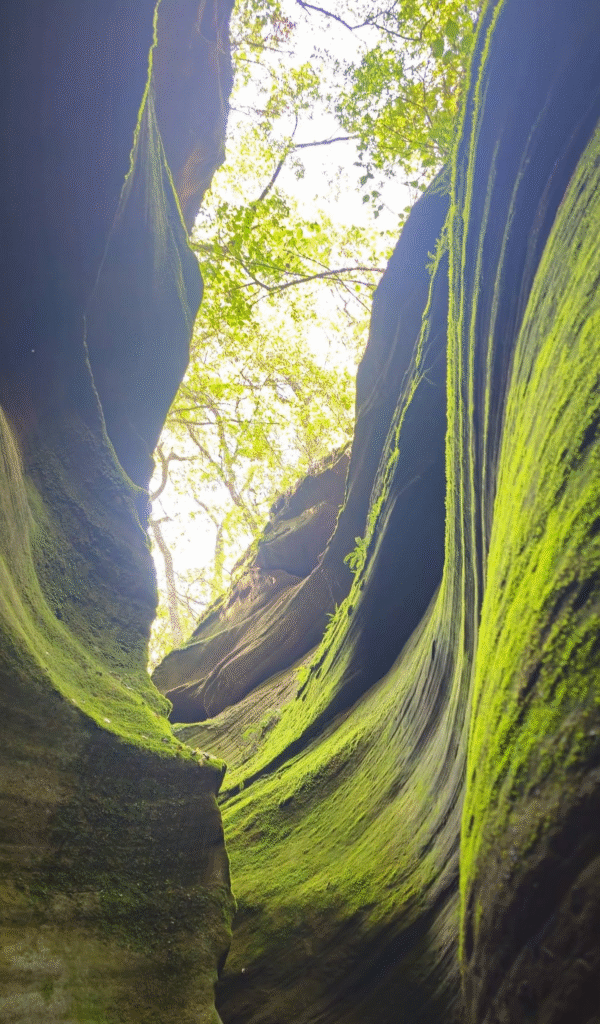
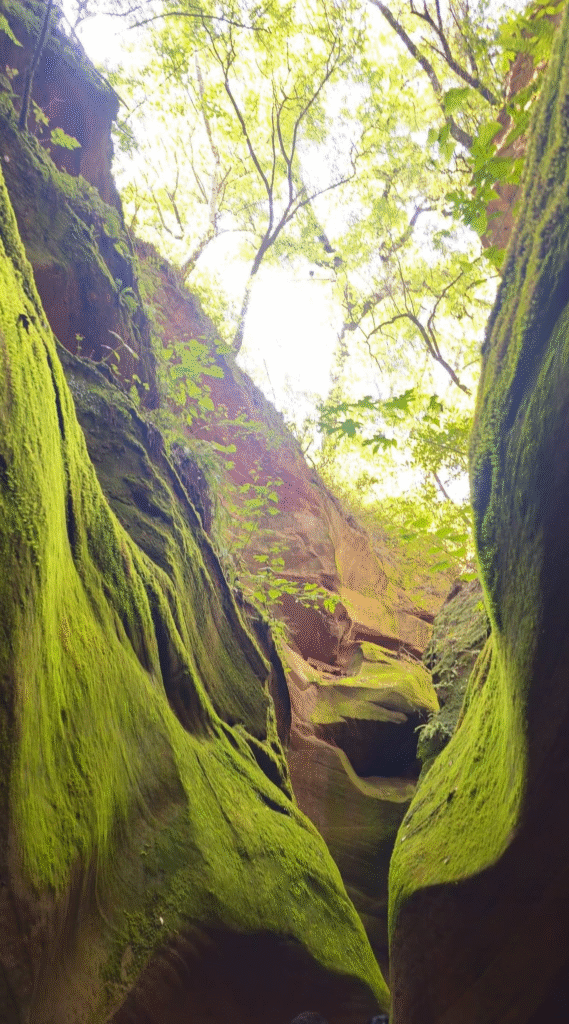
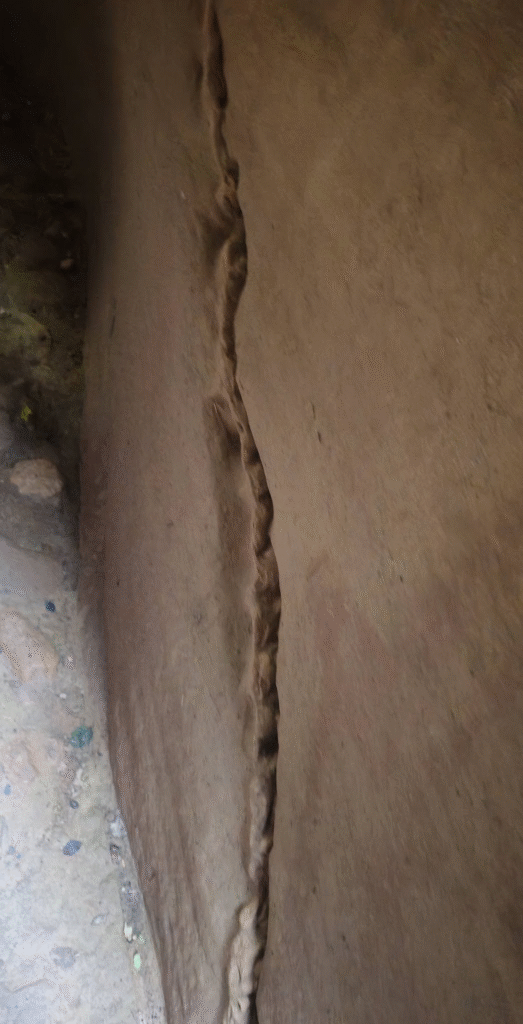
Its extraordinary narrow, twisting corridors were carved into red sandstone through long-term geological processes involving water erosion and weathering. Some accounts also associate the canyon’s formation with ancient tectonic activity that created cracks in the landscape, which were subsequently enlarged by rainwater erosion.The canyon’s sculpted walls, curves and changing light make it feel almost unreal — as though someone had taken a paintbrush and carved a masterpiece into the sandstone.
The Terracotta Army was created by human hands. Ganquan Grand Canyon was created by nature — and both left me equally speechless.
And Then I Met a Brown Panda!
Most of us picture a giant panda as black and white. But in the Qinling Mountains of Shaanxi, there is an extraordinarily rare brown-and-white form of giant panda known as the Qinling panda.
The Qinling population is geographically restricted to the Qinling Mountains. Brown pandas have been recorded only from this region. The famous Qizai, rescued as a young panda from the Foping Nature Reserve in 2009, is currently the only brown panda in captivity.


Scientists have identified a genetic mutation involving the Bace2 gene that is strongly associated with the brown-and-white coat color. Research indicates that a 25-base-pair deletion in the gene is the likely genetic basis for the unusual coloring.
Before Qizai, there was another famous brown panda, Dandan, rescued from the Foping Nature Reserve in 1985. She was taken to Xi’an for study and breeding, but her offspring were black-and-white. Dandan died in 2000.
My journey through Xi’an reminded me that history is not always found inside a museum.
Sometimes it stands silently in rows beneath the earth, waiting for someone to discover it. Sometimes it is found in the worn stones of an ancient village, where families lived their lives generation after generation. Sometimes it is a great city wall that has watched empires rise and fall. And sometimes, surprisingly, it is hidden in the mountains in the form of a very rare brown-and-white panda.
From the Terracotta Warriors of Qin Shi Huang to the ancient lanes of Dangjia Village, from the magnificent Xi’an City Wall to the sculpted beauty of Ganquan Grand Canyon, Shaanxi revealed itself to me as a place where history and nature exist side by side.
And perhaps that is what I enjoyed most about this journey. I didn’t simply visit places. I encountered stories — stories of emperors and ordinary families, of armies and architecture, of mountains shaped by time and animals shaped by nature.
I arrived in Xi’an expecting to see the past.
I left feeling that I had walked through it.
Xi’an is not a city you simply visit for its famous warriors. It is a place where every layer reveals another story.